Rebstudiet’s approach
From Craft to Presence
Rebstudiet is a place for kinbaku, depth and curiosity. We teach elements and principles so that students learn to understand, explore and adapt what they do with rope.
We do not primarily teach people ties. We teach people how to tie.
We teach the principles behind tying, so you can understand, adapt and combine them rather than simply copy a pattern. This means working with the rope’s function, the body, direction, tension, frictions and structure. Finished ties may form part of the teaching, but the aim is to see why they work, troubleshoot them and combine the elements yourself.
Semenawa is our primary direction. Kinbaku is the language; Semenawa is our dialect. As with a language, you learn words and grammar so that you can express something of your own.
Rebstudiet’s practice model
A living practice
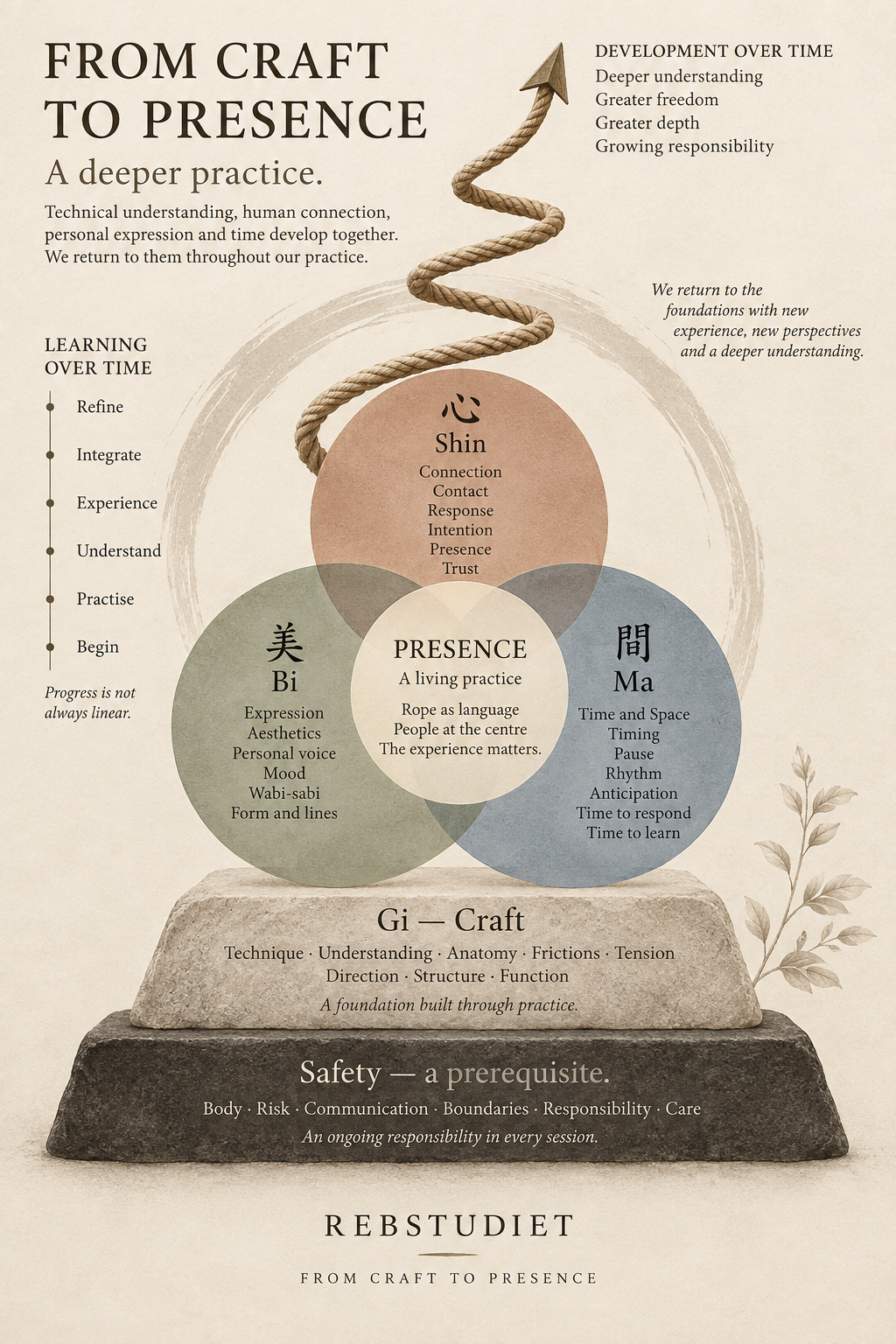
The model shows how safety, craft, connection, expression and timing relate to one another in our teaching. Presence is at the centre, while the spiral shows how we return to the same foundations with new experience.
Explore the model
Safety – A prerequisite
Safety underpins the entire model. It is an ongoing responsibility for the body, load, communication, clarity and care, rather than a stage that can be completed.
We work within what we have learned and understand, and we adapt when the situation changes. Without safety, there is no practice.
Gi – Craft
Gi is the technical foundation: rope handling, anatomy, frictions, tension, direction, structure and function. We work with one rope at a time and finish it before adding the next. Each rope has its own function and intention. We practise adapting and troubleshooting rather than merely copying a form.
Repetition makes the movements more familiar and less demanding of attention, leaving more room to follow the rope model. Connection, expression and timing are nevertheless part of the work from the beginning.
Shin – Connection
Shin describes the connection between the rigger and rope model. The rope model is an active participant, and communication, boundaries and responses are followed throughout the session.
Rope can be used to listen and respond: change direction, adjust the load, remain in a moment or stop.
Bi – Expression
Bi includes aesthetics, form and lines, as well as the atmosphere and personal voice created by our choices. The same technical structure can take on different expressions depending on the rigger, model, connection and situation.
Aesthetics are therefore part of the communication. They must never cause the model’s boundaries or responses to recede into the background.
Ma – Time and Space
Ma directs attention towards timing, rhythm, pauses and what happens between actions. The next rope does not have to be added at once; the body and connection may need time.
A pause is an active choice when it is used to register a response and decide what should happen next.
Presence – A living practice
Craft, connection, expression and time meet at the centre. Presence means noticing what is happening and adapting your choices to the person and the situation.
What matters most is what happens between the participants, rather than the position in which they end. Rope becomes a language when technique and attention work together.
The spiral
The spiral shows that we return to the same elements with new experience. It is not a ladder of rank, and development does not always move forwards evenly.
An experienced rigger never leaves Gi behind, and safety remains the prerequisite. Ma refers both to time within an individual session and to the time it takes to learn.
Each return can bring greater understanding, freedom, depth and responsibility. This is the movement from craft to presence.
Elements, practice and feedback
How we teach
Finished ties can serve as exercises and shared reference points, but reproducing them is not the learning objective. We divide the work into elements so that students can examine tension, direction, frictions, structure and the body’s response.
Students learn to see what a rope does, identify the cause when something does not work and adapt the solution. Combining elements yourself requires an understanding of their function and consequences.
Each rope has a function and an intention
We work with one rope at a time and finish it before adding the next. Each rope has its own function and intention. We make deliberate choices about placement, tension, pace and the time we give each rope. We do not add the next rope simply because it is the next step in a pattern.
In teaching, we practise both understanding each rope and combining elements into ties of our own. We use repetition to make the craft more familiar. Feedback concerns both the technique and the connection with the model, so that good choices can be repeated and unhelpful choices changed.
Development is reflected in better understanding and more precise choices, rather than the number of patterns you can remember or how quickly you reach a particular position.
What does the rope do here?
How do direction and tension affect the body?
What does the model’s response tell us?
What should be retained, changed or removed?
Form, atmosphere and personal voice
Aesthetics and personal expression
Expression grows from specific choices: the placement of the rope, lines and asymmetry, the shape of the body, the pace and the way each rope is finished. The rope should support the intended expression without hiding the body or creating unnecessary visual noise.
The same structure can look and feel different depending on the rigger, model and situation. This is where technical understanding and personal voice meet.
Japanese inspiration
Our way of seeing is inspired in part by seven Japanese aesthetic concepts. We use them as points of attention in our own work, rather than as a complete rulebook for kinbaku.
Wabi-sabi is another influence in the way we look at the imperfect and impermanent. It helps us make room for the human rather than pursue a flawless image.
The circle in which we tie
The incomplete circle in our logo represents the fact that we never finish learning. It is formed from jute, the material we tie with.
Responsibility in the session
Our principles
Safety is a prerequisite
We work within what we have learned and understand. Safety requires attention and adaptation throughout the session.
The person comes before the tie
The model’s boundaries and responses carry more weight than the tie or outcome that was planned.
We take responsibility for our choices
Responsibility applies to beginners and experienced practitioners alike. Ambition and intensity must be accompanied by an understanding of the possible consequences.
We stay within what was agreed
Before the session, we agree on boundaries and what it will include. We do not expand that agreement during the session. If we have agreed that there will be no sexual activity, that remains the agreement even if either person wants more once the session is underway. Either person can always withdraw consent, narrow the agreement or stop. Any wish to go beyond what was agreed is discussed later, outside the session.
We tie with intention
We make deliberate choices about placement, tension, pace and time. Each rope has a function, and we should be able to explain what we intend it to do.
The experience comes before the outcome
What matters most is what happens between the participants, rather than completing a particular tie or creating a particular image.
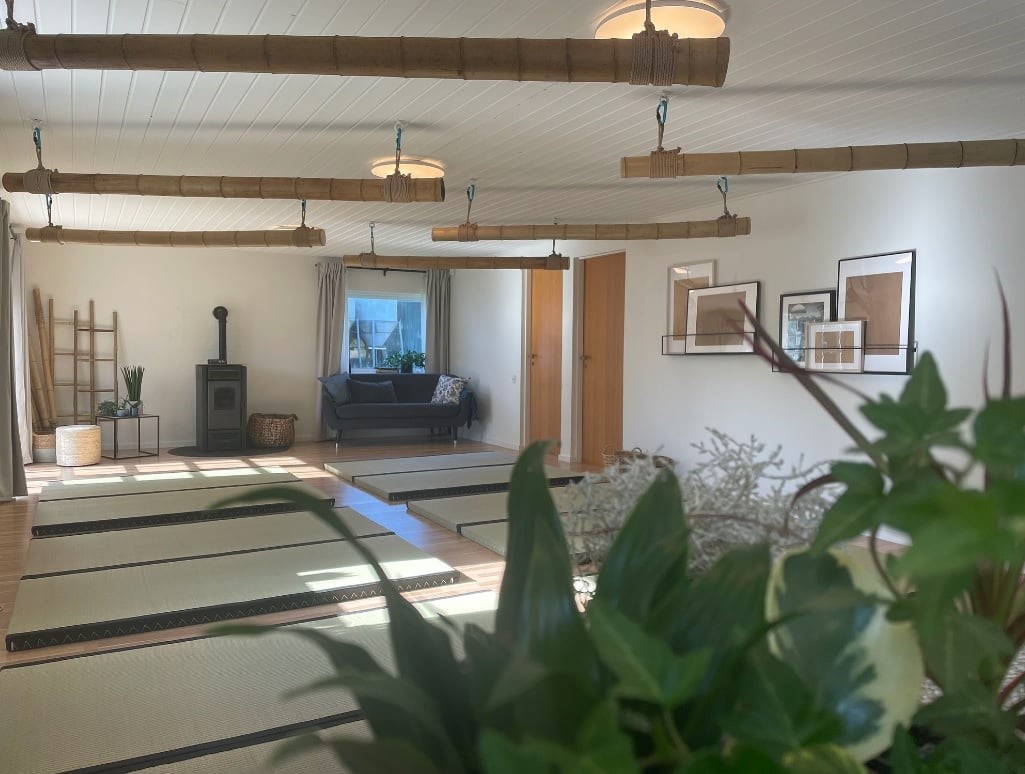
A place to learn and practise
Rebstudiet in Vrå
Rebstudiet is located in Vrå in North Jutland, Denmark. Here, you can learn, practise and deepen your understanding of kinbaku, with time for questions, repetition and feedback.
The teaching provides a technical foundation and tools for developing your own ties and making choices that follow the model’s response.