
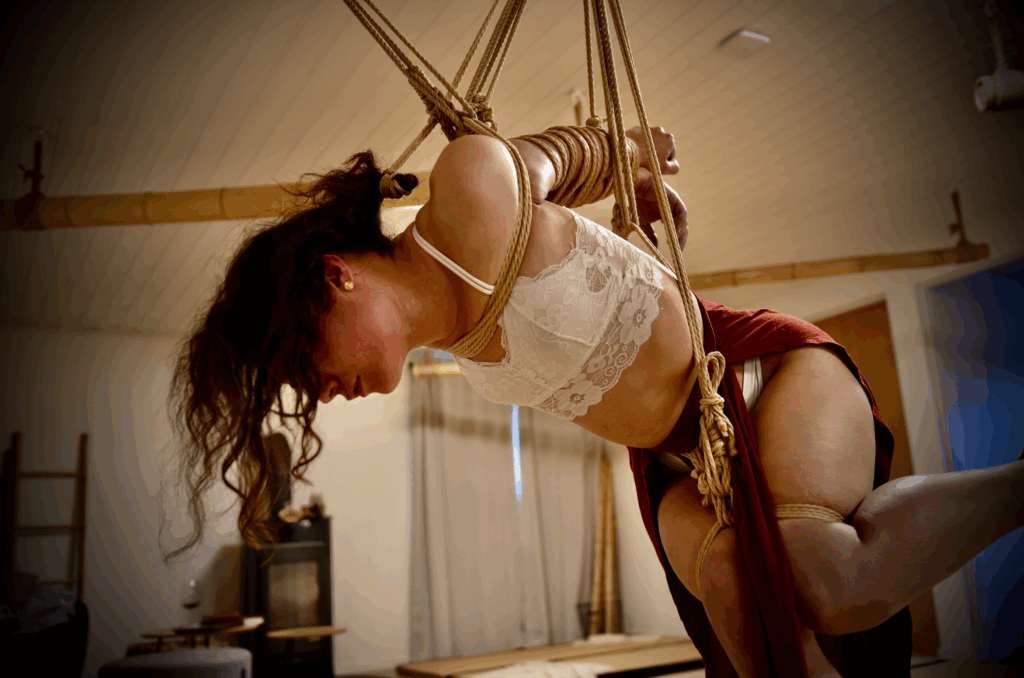
Tying is more than a technical skill or a physical activity. For many of us — and for me — it is a language. A quiet, intense language in which rope shapes the body, not only through friction but through meaning. A language in which every line, every knot and every pause carries a message. We tie because we long to say something that cannot be expressed in words.
We tie in order to see. Not only the body, but the person. The shape, the breath, the smallest tensions in the skin. We have an eye for beauty, but not for perfection. We seek what is imperfect, alive and honest. We draw inspiration from wabi-sabi, from what is decaying, temporary and vulnerable. We let the rope follow the landscape of the body, not hiding it but bringing it into view: a hip, the curve of a spine, a bare ankle. We tie because we want to make our rope model more beautiful — not in an idealised sense, but as a sensual, real and exposed version of themselves.
This approach calls for something other than quick movements and loose aesthetics. At Rebstudiet, we tie with an eye for the whole. Every small detail matters: the angle of a line, the rhythm of a tightening, the sound of jute against skin. Every movement has an intention, and every rope has a function. Not only a physical function, but an effect that can open the body from within. We do not tie at random. We do not place a rope without knowing why. Every layer is an invitation, a challenge, a possibility — a possibility for the model to feel themselves more keenly, deeply and honestly.
We know that rope can be used for many things. It can also attract, seduce or make things shallow. Some people take up rope not to express something, but to obtain something. They forget that rope does not conceal poor intentions; it magnifies them. When rope becomes a means of access rather than connection, it becomes empty. When aesthetics give way to desire and form is overshadowed by pursuit, something precious is reduced to something ordinary. Rope is not the problem; the problem lies in the hands that carry it without understanding.
Semenawa is a natural part of our practice. Not as something brutal, but as an intense insistence. A sensation that presses, yes, but also refines. It awakens layers in the body and mind that would otherwise remain hidden. When we tie with intensity, we do so not to take, but to draw something out: an opening, a surrender, a mirror. In the tension between pain and stillness, between stopping and continuing, there is a possibility of insight. A rope can pull at the skin, but it can also draw something out of the model — something they may not have known they carried.
We tie to feel time. Kinbaku refuses to hurry. It demands attention and rewards presence. It takes time to see a body — truly to see it. It takes time to listen with the hands. And it takes time to understand when a rope holds the body, and when it holds the mind.
We tie for the sake of connection. Not as something broad and social, but as something narrow and precise. An intense space between two people, with no room for masks. Kinbaku is intimacy in the field of tension between trust and control, between tenderness and boundaries, between gaze and touch. We tie because we want to meet the other person — and ourselves — in the place where nothing can be hidden.
And we tie because we cannot help it. Because something in us longs for what is raw, sensual and real. Perhaps it begins in the hand, with the longing for the texture of jute. Perhaps it begins in the skin, with the wish to be met by shape, structure and resistance. But the longing reaches deeper. It is about connection. About meaning. About a form of honesty that arises only in the taut space between two people and a rope.
For us, rope is not a technique but a form of expression. Not a performance but a practice. A study of body, sensation and closeness. A place where, with intensity and stillness, we explore what it means to be human together with another person.
Derfor binder vi…
jeg vil gerne lærer at binde, det vigtigste at starte med for mig er at lave et fullbody harness og blive fortrolig med rebet i dette inden jeg begynder på nogen suspension for at undgå at ilten bliver afskåret nogen steder, tror det tager rigtig meget ævelse og derfor vil jeg rigtig gerne starte allerede.
Tak for din kommentar Sebastian – og din tilgang med at blive fortrolig med rebene inden nogen form for suspension er ganske fornuftigt. Hvis du er interesseret i at lære at binde kan vi kun anbefale dig at du og din model deltager i vores workshops. På vores begynderworkshops (bl.a. denne weekend) får du grundlæggende viden om rebene og deres funktioner, samt øvelser du kan lege med hjemme for at blive bedre. Min anbefaling er, at du starter med niveau 1 og får øvet de ting du lærer der inden du hopper videre på niveau 2. Skriv endelig hvis du har flere spørgsmål enten her, på vores e-mail eller via vores kontaktformular.